How the “De Jozef” school Brings Lessons Outside with the Memo Outdoor Classroom
How do you turn a school playground into a place where children do more than play? At De Jozefschool in Weesp, the answer started with a clear educational ambition: to give movement-based learning a stronger, more practical role in the school day. We spoke with Yvette Tol, school leader at De Jozefschool, about the school’s experience with the Memo Outdoor Classroom, how pupils respond to learning outside, and what other schools can learn from their approach.
Do you have a question for Yvette after reading this article? If so, please get in touch with her at y.tol@askoscholen.nl.

A growing school with a clear ambition
When De Jozefschool moved into its new school building in 2021, the team had an opportunity to think carefully about the role of the outdoor space. The school chose Lappset’s interactive Memo as part of the new playground, not simply as an extra play feature, but as a way to support a broader vision: making movement-based learning part of everyday education.
For Yvette Tol, this was never about adding something separate to the curriculum. It was about giving students another way to engage with lesson content.
That mattered even more as the school grew rapidly. In a short time, De Jozefschool developed into a primary school with 600 students across two locations. In that context, the playground became more than a place to let off steam. It became a valuable extension of the learning environment.
From interactive play equipment to the outdoor learning concept
The Memo is designed to make learning active, social and engaging. With seven pillars, each featuring a 360° LED touchscreen, children can interact with games from every angle. The name Memo reflects two ideas at the heart of the concept: memory and movement, both essential to effective learning.
Through active play, pupils practise more than subject knowledge. The games encourage teamwork, cooperation and communication, while keeping children moving throughout the activity. They also support the development of 21st-century skills, STEM learning and healthy, active habits.
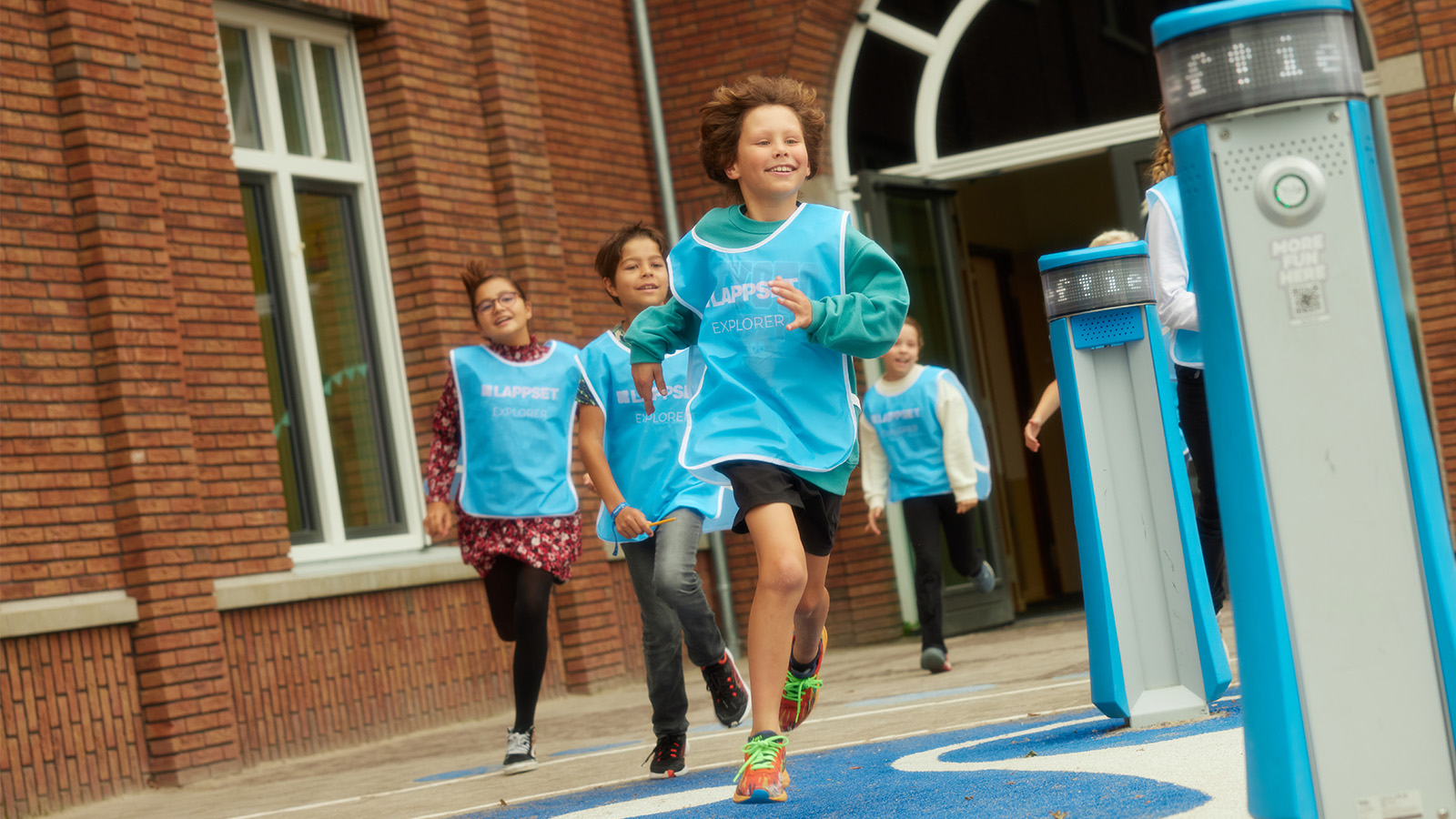
The Memo Outdoor Classroom builds on this foundation. It turns the Memo from an interactive play device into a complete educational concept for use during the school day. The concept includes a didactic guide, vests, lesson cards and worksheets that help teachers bring structured learning outside.
Each Memo game can become a lesson. For every game, a lesson card has been developed, linking the activity to clear learning goals. These lessons connect to hard skills, such as maths, language and music, with objectives tested against Dutch and Finnish educational standards. They also support soft skills, including 21st-century skills and STE(A)M learning.
For primary schools, this combination is what makes the Memo Outdoor Classroom so valuable. It gives teachers a practical way to connect language, maths and other learning goals with movement. In doing so, active learning becomes more than an occasional activity outside; it becomes a natural part of the school day.
Helping shape a practical tool for teachers
In 2022, De Jozefschool contributed to research into the Memo Outdoor Classroom. The school provided practical feedback on how the concept could be used during the school day, how the games were structured, and how clear the materials were for teachers.
That feedback helped shape a usable didactic guide aligned with the curriculum and the daily reality of primary schools.
For Yvette, this practical usability is essential. Movement-based learning only works when teachers can actually apply it within a busy school day. The strength of the Memo Outdoor Classroom, she explains, lies in the clarity of the materials.
Teachers can quickly see the purpose of an activity, what pupils are learning, and how the difficulty level builds up. That makes it easier to use the Memo intentionally, rather than occasionally.
The supporting materials also lower the threshold for going outside. The didactic guide and worksheets give teachers structure, while still leaving room for their own professional judgement.

As Yvette puts it:
“Teachers can pick it up quickly and use it directly in practice. The supplied material is well developed and still leaves enough room for personal interpretation. No additional pedagogical guidance or experience is needed. It is precisely this freedom that makes it workable, because the expertise for implementation remains with the teachers and the school itself.”
That balance is important. The Memo Outdoor Classroom is not a rigid programme that tells teachers exactly what to do. It gives them a framework they can make their own.
What pupils gain from learning outside
For pupils, the Memo Outdoor Classroom brings more variety into the school day. Learning outside creates space for movement, collaboration and active engagement with lesson content.
According to Yvette, it contributes to greater enjoyment in learning, more independence and a different kind of involvement in education. Pupils benefit from:
- More enjoyment in learning
- More movement during the school day
- More variety beyond the classroom
- More room for independence
- More ownership and involvement in their own learning process
- More opportunities to collaborate and learn from one another
- Opportunities for mixed-group learning, with multiple year groups working together
- One of the most striking outcomes at De Jozefschool is that learning does not stop when the lesson ends.
During breaks and after school, pupils often choose educational games on the Memo of their own accord. In the top 10 most-played games, no fewer than seven are educational. These include the social-emotional game Story maker, spelling exercises, an alphabet competition, More music in the class games and even maths games.
For Yvette, that says a great deal about the natural connection between play and learning.
“The pupils choose to engage with educational games during their free moments. Yes, fantastic. What more could you want? We see it happening on the playground in practice, and the statistics we can view through the Lappset Dashboard confirm it!”
Learning together, step by step
The value of the Memo Outdoor Classroom is also visible in the way pupils work together. The concept aligns well with the principle of scaffolding, where pupils support each other step by step during the learning process.
Working in smaller groups gives children more ownership of their learning. The focus is not only on instruction from teacher to pupil, but also on pupil-to-pupil learning. Exploring together, working together and reflecting together become a natural part of the activity.
A pupil can, for example, take on the role of guide and help make sure everyone in the group understands the lesson content. This strengthens not only engagement but also the pupils’ sense of responsibility.


What teachers gain from the Memo Outdoor Classroom
For teachers, the Memo Outdoor Classroom offers a practical way to make movement-based learning easier to use in everyday teaching.
The didactic guide, lesson cards and worksheets provide an overview and require little preparation. The main benefits for teachers include:
- Less preparation thanks to fully developed lessons in the manuals
- A practical way to use movement-based learning
- More structure in building up activities
- Room for pupils to work at their own level
- Suitable for ready-to-go assignments, extra challenge and additional practice
- More opportunities for pupils to work independently and collaboratively
- Suitable for mixed-group learning, where multiple year groups work together
In other words, the Memo Outdoor Classroom helps teachers move active learning from intention to practice.
From playground to learning environment
The story of De Jozefschool shows that movement-based learning is strongest when it connects with the daily reality of school life. That is where the Memo Outdoor Classroom makes a difference.
It does not simply add an interactive device to the playground. It gives teachers a practical approach for using outdoor space as part of education, helping pupils learn through movement, collaboration and play.
At De Jozefschool, the playground has become more than a place between lessons. It has become a place where learning continues, sometimes even when pupils are free to choose for themselves.

Children playing on the Lappset Memo | Lappset Nederland
Advice for other schools: start small and make it your own
De Jozefschool’s experience shows that there is no single fixed way to work with the Memo Outdoor Classroom. That is exactly what makes the concept usable for primary schools. Every school has its own team, its own daily rhythm and its own educational priorities.
Yvette advises schools to first decide what they want to achieve with the Memo. Is the goal to do more with movement-based learning? To offer language and maths outside more often? Or to help pupils work more independently?
- Her practical advice is clear:
- Start small and do not make it too big too quickly.
- Decide in advance what your goal is with the Memo.
- Keep the materials and manuals in a central place.
- Use a schedule if several groups are using the Memo.
- Build pupils’ independence step by step.
- Consider letting older pupils support younger pupils.
- Appoint one person in the school as the knowledge holder and point of contact for other teachers.
That final point is especially important. According to Yvette, this role should suit the person well, because implementing something new requires enthusiasm and perseverance.
She also recommends letting teachers discover the Memo for themselves first. When a team tries it out together in a practical way, it becomes easier to build its use into the school routine.
A team day can be a good moment for this. It is not only educational, but also enjoyable: teachers are outside, active and able to experience what pupils experience. It helps them feel the strength of playful, active learning for themselves.